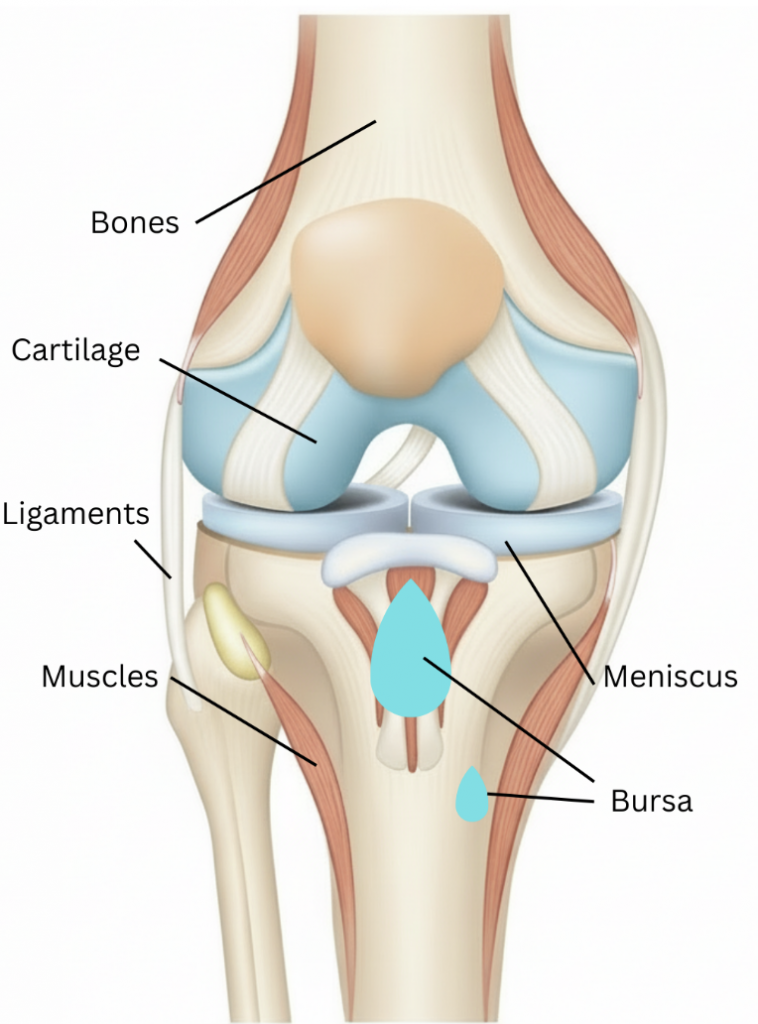
Before diving into causes, it helps to know what’s going on inside your knee when you bend:
- Bones: Thigh bone (femur), shin bone (tibia), and kneecap (patella)
- Cartilage: Cushions the bones and allows smooth movement
- Meniscus: Two C-shaped cartilage pads that act as shock absorbers
- Ligaments: Keep the knee stable (ACL, PCL, MCL, LCL)
- Muscles & Tendons: Quadriceps, hamstrings, calves — help bend, straighten, and support the knee
- Bursa: Small fluid-filled sacs that reduce friction
When you bend your knee, these structures glide, stretch, and compress. Pain happens when one or more are strained, inflamed, injured, or worn down.
Common Causes of Knee Pain When Bending
1. Patellofemoral Pain Syndrome (Runner’s Knee)
Patellofemoral pain syndrome is a common condition characterised by discomfort around or behind the kneecap. It often affects runners, cyclists, gym-goers, and individuals who spend long hours sitting. This type of knee pain usually occurs when the kneecap does not glide smoothly in its groove. Contributing factors may include weak hip or thigh muscles, overuse, poor exercise technique, and foot mechanics such as flat feet or unsupportive footwear.
How it shows up: Pain around or behind the kneecap; Dull ache in the front of the knee, worse with stairs, squatting, sitting.
Who it affects: Runners, cyclists, active individuals, office workers who sit for long hours.
Triggers: Patella not tracking smoothly; Weak hip or thigh muscles; Overuse or improper training technique; Flat feet or improper footwear
2. Patellar Tendonitis (Jumper’s Knee)
Patellar tendonitis involves irritation of the tendon connecting the kneecap to the shin bone. It commonly affects individuals who participate in activities that involve repeated jumping or running, such as basketball, volleyball, and track sports. The condition may also develop when training intensity increases suddenly or when exercising on hard surfaces.
How it shows up: Sharp pain below the kneecap when bending or jumping.
Who it affects: Active individuals such as basketball players, volleyball players and runners. Triggers: Jumping sports (basketball, volleyball); Running on hard surfaces; Sudden increase in training intensity
3. Meniscus Tear
The meniscus is a key piece of cartilage that cushions the knee and helps stabilise the joint. A meniscus tear can occur from a sudden twisting movement, deep squatting under load, or gradual degeneration over time. People with a meniscus injury may experience pain when bending or twisting the knee, along with swelling, stiffness, and a sensation of the knee clicking, catching, or locking. In some cases, the knee may feel as though it might “catch” mid-movement.
How it shows up: Pain when bending or twisting; Clicking or locking sensations; Swelling and stiffness; Feeling like the knee might “catch”
Who it affects: Anybody
Triggers: Sudden twisting motions; Squatting with heavy load; Age-related degeneration
4. Osteoarthritis
Osteoarthritis is a progressive condition caused by the gradual breakdown of knee cartilage. It is more common among older adults, individuals with previous knee injuries, and those who place repetitive stress on their joints.
How it shows up: Pain when bending or standing after sitting; Morning stiffness; Creaking or grinding sensation (crepitus); Swelling and gradual progression
Who it affects: Middle-aged and older adults; Individuals with previous knee injuries; Those with repetitive stress on joints
5. Bursitis
Bursitis occurs when the bursae (small fluid-filled sacs that cushion the knee) become inflamed. This may result from frequent kneeling, direct impact, or repetitive overuse.
How it shows up: Swelling in front or inner side of the knee; Tenderness when kneeling or bending.
Who it affects: Older people; People who play high-impact or repetitive sports; People who work as cleaners, gardeners, plumbers, electricians and floor installers; People who pray kneeling regularly
Triggers: Frequent kneeling (cleaning, gardening); Direct impact; Overuse
6. Iliotibial (IT) Band Syndrome
Iliotibial band syndrome causes pain on the outer side of the knee. The condition develops when the IT band rubs repeatedly against the bony structure on the outside of the knee during bending and movement. Over time, this friction leads to irritation and pain.
How it shows up: Pain on the outer side of the knee
Who it affects: Runners; Cyclists; Hikers; People with tight hip muscles; People with weak glutes
Triggers: Running; Cycling; Hiking
7. Muscle Strain or Imbalance
Muscle tightness or weakness around the knee can disrupt normal movement patterns and increase stress on the joint. Tight or weak muscles around the knee change how force is distributed. For example, tight hamstrings may place added strain on the knee, while weak quadriceps can affect proper kneecap tracking. This type of pain often appears after sudden bursts of exercise without an adequate warm-up, or after periods of inactivity.
How it shows up: General ache or tightness when bending or standing up from sitting
Who it affects: Everybody
Triggers: Standing after sitting; Improper warm-up before exercising
8. Ligament Injury (Sprain)
Ligament sprains often result from sudden twisting or pivoting movements, particularly during sports. Even a mild sprain can cause discomfort when bending the knee.
How it shows up: Sharp pain; Instability or “giving way”; Swelling shortly after injury
Who it affects: Active people, People who play sports
Triggers: Playing sports without warming up correctly
9. Baker’s Cyst
A Baker’s cyst is a fluid-filled swelling that forms behind the knee. It can develop as a result of underlying joint irritation or arthritis.
How it shows up: Swelling and tightness at the back of the knee, noticeably when bending or straightening the leg
Who it affects: People with knee arthritis; People with knee injuries; Athletes; Older people
Triggers: Bending or straightening the leg
Less Common Causes of Knee Pain When Bending:
While rarer, these conditions can also cause pain when bending the knee:
- Plica syndrome (irritated knee fold tissue)
- Chondromalacia patella (softened kneecap cartilage)
- Loose fragments in the joint
- Inflammatory joint conditions
- Stress fractures (especially in athletes)
Why Knee Pain Often Shows Up When Bending
Bending puts pressure on cartilage and tendons while stretching ligaments and muscles. If any structure is irritated, bending becomes a trigger activity.
For many conditions, pain appears during:
- Squatting or lunging
- Going up/down stairs
- Getting in/out of a car
- Sitting cross-legged
- Kneeling
- Prolonged sitting (“movie-theatre knee”)
Self-Care Tips That May Help Reduce Knee Pain
Mild symptoms sometimes improve with supportive measures:
- Rest from aggravating activity
- Ice the knee to reduce irritation
- Gentle stretching (hamstrings, calves, quadriceps)
- Strengthen surrounding muscles gradually
- Maintain a healthy body weight
- Use supportive shoes
- Avoid sudden increases in training intensity
Listening to your body is key; pushing through pain may worsen certain injuries.
When to Consider Seeing a Doctor
You may want to seek medical evaluation if you experience:
- Persistent pain that doesn’t improve
- Swelling, warmth, or redness
- Knee locking or catching
- Feeling of instability or “giving way”
- Pain after a fall or sudden twist
- Significant difficulty bending or straightening the knee
- Night pain or pain at rest
Early assessment can help identify the cause and guide appropriate management.
If knee pain is affecting daily life, exercise, or mobility, speaking with a qualified healthcare professional can help determine the cause and discuss supportive options tailored to your needs.