Introduction
At Total Orthopaedic Care & Surgery, we adopt a special approach to help your knees stay strong and functional for as long as possible. It’s called the “knee preservation approach,” and it’s all about keeping your knees in their best shape, much like taking care of a prized possession.
Imagine your knees as the hinges of a door that allow you to walk, run, and move around. Over time, like any other important part of our bodies, knees can experience wear and tear. However, instead of immediately considering major procedures like knee replacement, we’re going to focus on preserving and enhancing the health of your natural knee joints.
What is Knee Preservation?
Knee preservation is like a team effort between you, us, and your body. Instead of rushing into major surgeries, we aim to keep your knee joint as close to its natural state as possible. This involves carefully assessing your knee’s condition and working together to find strategies that will improve its function and reduce pain.
Understanding the Approach
Personalized Plans:
First, we'll sit down and have a chat. We want to know about your lifestyle, activities, and how your knee issues are affecting you. This helps us create a plan that suits your individual needs.
Conservative Treatments:
We'll start with non-surgical options like physiotherapy, exercises, medications, and lifestyle changes. These steps can help manage pain and enhance your knee's stability.
Joint-Friendly Procedures:
If needed, we might consider less invasive procedures that focus on fixing specific problems within your knee. Think of these as small repairs to keep your knee working smoothly.
Knee Osteotomy:
In some cases, we might perform a knee osteotomy. This means making calculated adjustments to the bones around your knee joint to improve its alignment. It's like realigning a car's wheels to ensure a smoother ride.
Arthroscopy:
This is a minimally invasive procedure where we use a tiny camera to diagnose and sometimes treat knee issues. It's like using a small telescope to look inside your knee and fix any minor problems.
Long-Term Outlook:
The goal of knee preservation is to help you maintain your own knee joint for as long as possible. This approach can delay or even eliminate the need for major surgeries like knee replacements.
Why Choose Knee Preservation?
Less Invasive:
The procedures involved in knee preservation are generally less invasive than major surgeries, meaning shorter recovery times and less disruption to your life.
Maintaining Natural Joints:
By aiming to preserve your natural knee joint, we help you keep the feeling and function that you're used to.
Longer-lasting Solutions:
Knee preservation can provide relief for years, helping you enjoy your favourite activities with less pain.

Who is knee preservation for?
Knee preservation suits people whose knee still has healthy cartilage in at least part of the joint, and who want to stay active on their own knee for longer. It is most often considered for:
- Younger and middle-aged adults with early arthritis on one side of the knee
- A bowed or knock-kneed leg that overloads the inner or outer side of the knee
- Sports injuries such as meniscus tears, ACL tears and cartilage damage
- People who want to delay a knee replacement for as long as is sensible
When arthritis is advanced across the whole knee, preservation treatments are less likely to help, and a knee replacement may give a better result. Your surgeon will explain which group your knee falls into.
Knee preservation treatments
Treatment is matched to the problem in your knee. Most people start with the simplest options, and surgery is considered only when it is likely to protect the joint or relieve pain that simpler treatment has not.
| Treatment | What it does | Read more |
|---|---|---|
| Exercise, weight management and bracing | Reduces the load on the worn part of the knee and eases pain | Knee osteoarthritis |
| Knee injections (steroid, PRP or gel) | Settles inflammation and pain in mild to moderate arthritis | Knee injections |
| Meniscus repair | Stitches a torn meniscus so it keeps cushioning the cartilage | Meniscus tears |
| Ligament reconstruction | Restores stability so the knee stops giving way and damaging the meniscus and cartilage | ACL tear |
| Cartilage repair | Repairs a contained cartilage defect before it spreads | Cartilage damage |
| Osteotomy | Realigns the leg to shift weight off the worn side of the knee | Knee malalignment |
| Partial knee replacement | Resurfaces only the worn compartment and keeps your own ligaments and healthy cartilage | Knee replacement |
What is a knee osteotomy?
An osteotomy straightens the leg so that your weight passes through the healthier side of the knee. It is the main joint-preserving operation for arthritis on one side of the knee in active patients.
- High tibial osteotomy (HTO) is used for bow legs with wear on the inner side. The shin bone just below the knee is cut and opened or closed to the planned angle, then held with a plate while it heals.
- Distal femoral osteotomy (DFO) is used for knock knees with wear on the outer side, and corrects the thigh bone just above the knee.
The correction is planned from full-length standing X-rays of both legs. After surgery you use crutches for several weeks while the bone heals, and recovery is guided by a physiotherapist. Because your own joint is kept, a knee replacement remains possible later if it is ever needed. Your surgeon will go through the expected recovery for your knee.
Why protect the meniscus and cartilage?
The meniscus and cartilage spread load across the knee. When part of a meniscus is removed, or a cartilage defect is left to grow, the remaining cartilage carries more load and arthritis can develop sooner. This is why repair is preferred to removal when the tear or defect allows it, and why an unstable knee is often stabilised before it causes further damage.
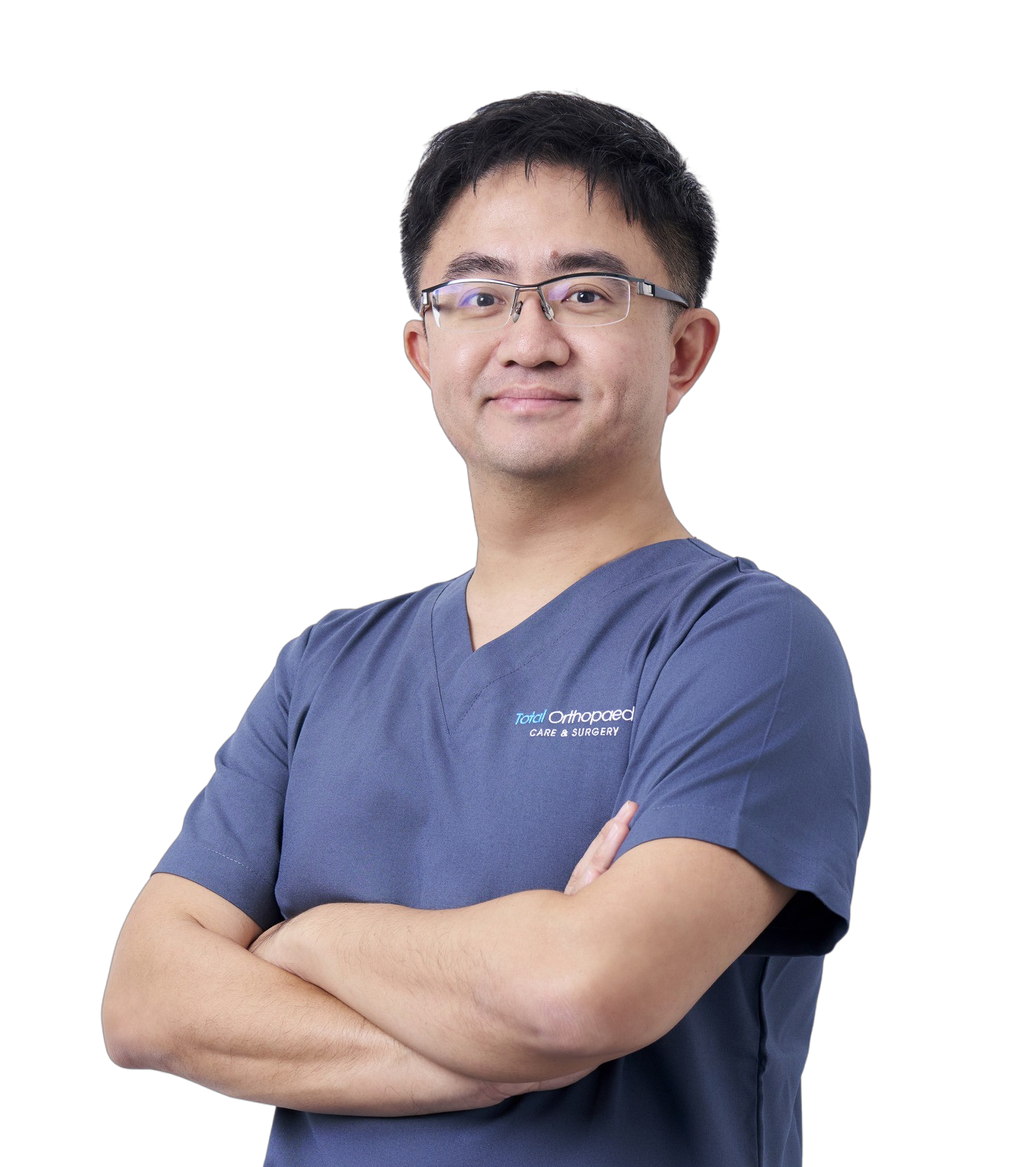
Your knee preservation surgeon: Dr Hamid Razak
Knee preservation at Total Orthopaedic is led by Dr Hamid Razak. He led the Sports & Joint Preserving Osteotomy Service at Sengkang General Hospital, trained on the Oxford Partial Knee at the Nuffield Orthopaedic Centre in Oxford, and was awarded the International Cartilage Regeneration & Joint Preservation Society Clinical Travelling Fellowship in 2023.

Consultant Orthopaedic Surgeon with over 17 years of experience. MBBS (NUS), MMed (Ortho Surg), FRCSEd (Orth), FRCSGlasg (Tr & Orth), FAMS (Orth Surg). Dr Hamid led the Sports & Joint Preserving Osteotomy Service at Sengkang General Hospital and is an Adjunct Associate Professor at Duke-NUS Medical School. He is a founding member and vice-president of the Singapore Knee Preservation Society, and operates at Mount Elizabeth Novena and Gleneagles Hospitals. Read Dr Hamid’s profile
Frequently asked questions
Is knee preservation only for young people?
No. Age matters less than the state of your knee and how active you want to be. It is most often used in younger and middle-aged adults, but older patients with wear on one side of the knee may also benefit.
If I have an osteotomy, can I still have a knee replacement later?
Yes. An osteotomy keeps your own joint, and a knee replacement can still be done later if the arthritis progresses.
How do I know which option suits me?
Your knee specialist will examine your knee and review standing X-rays, and sometimes an MRI, to see which parts of the joint are worn, whether the leg is aligned, and whether the ligaments and meniscus are intact.
To book a knee consultation, contact Total Orthopaedic. No referral is needed. The clinic sees patients in Novena, Orchard, Gleneagles and Tampines.
Conclusion
Remember, every knee is unique, and the knee preservation approach is all about finding what works best for you. We’re partners in this journey towards healthier knees, and we are here to guide you every step of the way. If you have any questions or concerns, please don’t hesitate to ask. Your knee health is our priority!