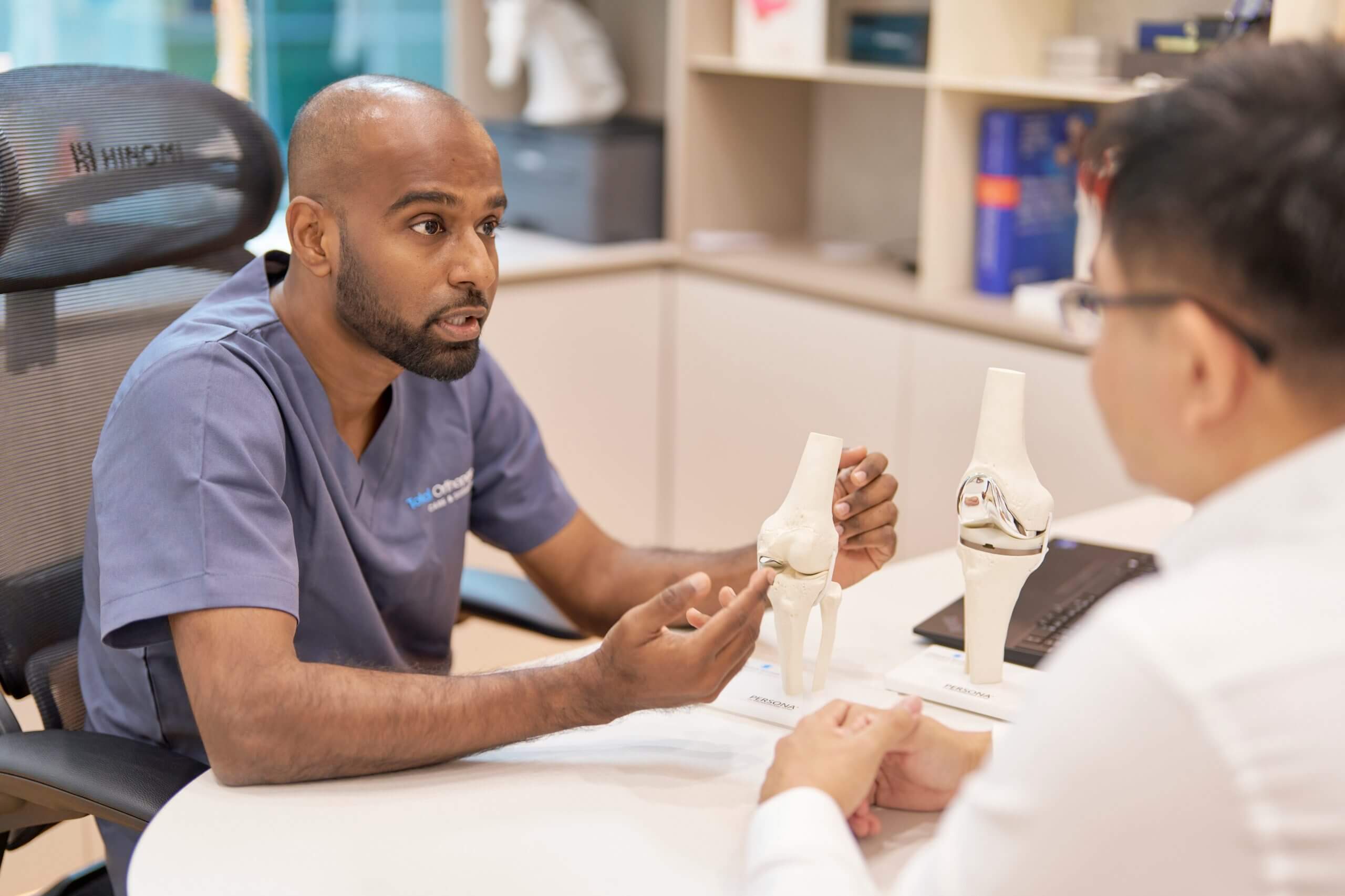
Knee replacement surgery replaces the worn joint surfaces of the knee with metal and plastic parts. It is recommended when arthritis causes pain that limits walking or sleep and has not improved with medication, exercise, weight loss or injections. A total knee replacement resurfaces the whole joint. A partial (unicompartmental) replacement resurfaces only the worn part.
At Total Orthopaedic, knee replacement is performed by Dr Hamid Razak. He trained on the Oxford Partial Knee at the Nuffield Orthopaedic Centre in Oxford, and he also performs joint-preserving osteotomy, which can delay or avoid a replacement for some patients.
When is knee replacement recommended?
Knee replacement is usually considered when X-rays show advanced arthritis and the pain still limits daily life after a fair trial of non-surgical treatment. Age alone does not decide it: what matters is how much the knee limits you and whether simpler treatment still helps.
Signs it may be time to discuss surgery:
- Knee pain that wakes you at night or is there even at rest
- Walking distance has shrunk to a few hundred metres, or you avoid stairs
- The knee has become bowed or knocked, or will not straighten fully
- Injections, medication and strengthening exercises no longer give lasting relief
Before replacement, your surgeon will go through the other options on the knee osteoarthritis treatment page, including knee injections.
Total vs partial knee replacement: what is the difference?
A partial knee replacement replaces one of the knee’s three compartments, usually the inner (medial) side, and keeps your own ligaments and healthy cartilage. A total knee replacement resurfaces all three. A partial replacement only suits knees where the arthritis is confined to one side and the ACL is intact.
| Partial (unicompartmental) knee replacement | Total knee replacement | |
|---|---|---|
| Who it suits | Arthritis in one compartment, intact ACL, knee that bends well | Arthritis across the knee, deformity or ligament damage |
| Incision | Smaller | Longer |
| Hospital stay | Often 1 to 2 nights | Usually 3 to 5 nights |
| Recovery | Usually faster, and the knee often feels more natural | Slower, with a longer period of swelling |
| Long-term | Higher chance of a second operation later | Most last 15 to 20 years or more |
Whether you are suitable for a partial replacement is decided from standing X-rays, sometimes an MRI, and examination of your ligaments.
Is robotic knee replacement available?
Yes. Dr Hamid performs robotic-assisted total and partial knee replacement. A CT scan of your knee is used to plan the implant size and position in 3D before surgery. During the operation, a robotic arm guided by the surgeon keeps the bone cuts within that plan.
The surgeon performs the operation throughout; the robotic arm limits cuts to the planned area. Robotic assistance improves how accurately the implant is positioned. Whether this leads to better long-term results than conventional surgery is still being studied, so your surgeon will discuss whether it suits your knee and how it affects the cost.
What happens on the day of surgery?
You are admitted on the morning of surgery. The operation takes about 1 to 2 hours under a spinal or general anaesthetic. Most patients stand and take their first steps with a walking frame on the same day or the day after.
- Pre-admission checks a week or two before: blood tests, ECG and a review of your medicines
- Anaesthetic: usually a spinal anaesthetic with sedation, plus a nerve block for pain relief
- Surgery: the worn surfaces are removed and the implant fitted to your bone
- On the ward: pain relief, blood clot prevention and first walk with the physiotherapist
- Home when you can walk safely with a frame or crutches and manage stairs
How long is recovery from knee replacement?
Most people walk with a stick by 2 to 6 weeks, drive again at around 6 weeks, and return to desk work at 6 to 8 weeks. Swelling and stiffness keep improving for 6 to 12 months. A partial replacement usually recovers faster.
| Time after surgery | What most people can do |
|---|---|
| Days 1 to 5 | Walking with a frame or crutches; going home |
| Weeks 2 to 6 | Walking with one stick, then without; exercises every day |
| Around 6 weeks | Driving, once you can brake firmly and walk without a stick |
| 6 to 12 weeks | Desk work, swimming, cycling on an exercise bike |
| 3 months | Most daily activities; golf and long walks |
| 6 to 12 months | Final result: swelling settles and strength returns |
Total Orthopaedic works with a network of physiotherapists and will refer you to one near your home or work for your rehabilitation.
How much does knee replacement cost in Singapore?
For one total knee replacement in a private hospital, the typical bill in 2023 was about S$43,000 (most between S$36,900 and S$48,600) before insurance. The Ministry of Health (MOH) fee benchmark for the surgeon is S$10,028 to S$13,080 including GST. MediSave, MediShield Life and Integrated Shield Plans can pay part of the bill, depending on your plan.
Total Orthopaedic follows the MOH fee benchmarks closely. These figures are MOH benchmarks and typical bills for a routine case, not a quote: your bill depends on the hospital, ward and complexity of your surgery. Ask the clinic for a written estimate before surgery.
| Fee | MOH benchmark or typical bill (incl. GST) |
|---|---|
| Surgeon’s fee | S$10,028 to S$13,080 |
| Anaesthetist’s fee | S$1,962 to S$2,834 |
| Hospital fees (private) | S$23,108 to S$28,776 |
| Typical total bill, private hospital inpatient | About S$43,138 (most S$36,895 to S$48,590) |
These are MOH figures for a routine, unilateral total knee replacement. Partial replacement, both knees, or a complex case are billed differently.
What are the risks of knee replacement?
Serious complications are uncommon. The main risks are infection, blood clots in the leg, stiffness, ongoing pain and, over many years, wear or loosening of the implant that may need a second operation.
Your surgeon will talk through your own risks, which depend on your health, weight and the state of your knee. Blood clot prevention and antibiotics are routine.
Your knee surgeon: Dr Hamid Razak
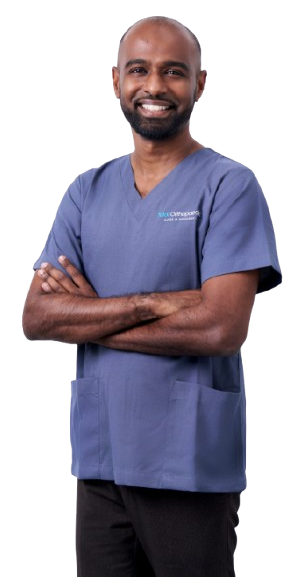
Consultant Orthopaedic Surgeon with over 17 years of experience. MBBS (NUS), MMed (Ortho Surg), FRCSEd (Orth), FRCSGlasg (Tr & Orth), FAMS (Orth Surg). Dr Hamid led the Sports & Joint Preserving Osteotomy Service at Sengkang General Hospital and is an Adjunct Associate Professor at Duke-NUS Medical School. He is a founding member and vice-president of the Singapore Knee Preservation Society, and operates at most of the private hospitals in Singapore. Read Dr Hamid’s profile
Frequently asked questions
Am I too young or too old for a knee replacement?
There is no fixed age. Younger, active patients with arthritis on one side of the knee may be offered an osteotomy or a partial replacement first, to keep their own joint for longer. Older patients are assessed on their general health rather than their age.
Can both knees be replaced at the same time?
Sometimes. It means one anaesthetic and one recovery, but a harder first few weeks. Your surgeon will advise based on your health.
How long does a knee replacement last?
Most total knee replacements still work well 15 to 20 years later. Partial replacements are more likely to need a second operation, sometimes converting to a total knee.
Is there an alternative to knee replacement?
For some people, yes: injections, a structured exercise programme, weight loss, bracing, or a realignment operation (osteotomy) that shifts weight off the worn side of the knee. See knee malalignment and the knee preservation approach.
To book a knee consultation, contact Total Orthopaedic. No referral is needed. The clinic sees patients in Novena, Orchard, Gleneagles and Tampines.
Medically reviewed by Dr Hamid Razak. Last updated October 2026. Sources: Ministry of Health fee benchmarks and 2023 bill information for total knee replacement (SB810K). This page is general information and does not replace a consultation.